
There’s a place a lot of people live without realizing it has a name.
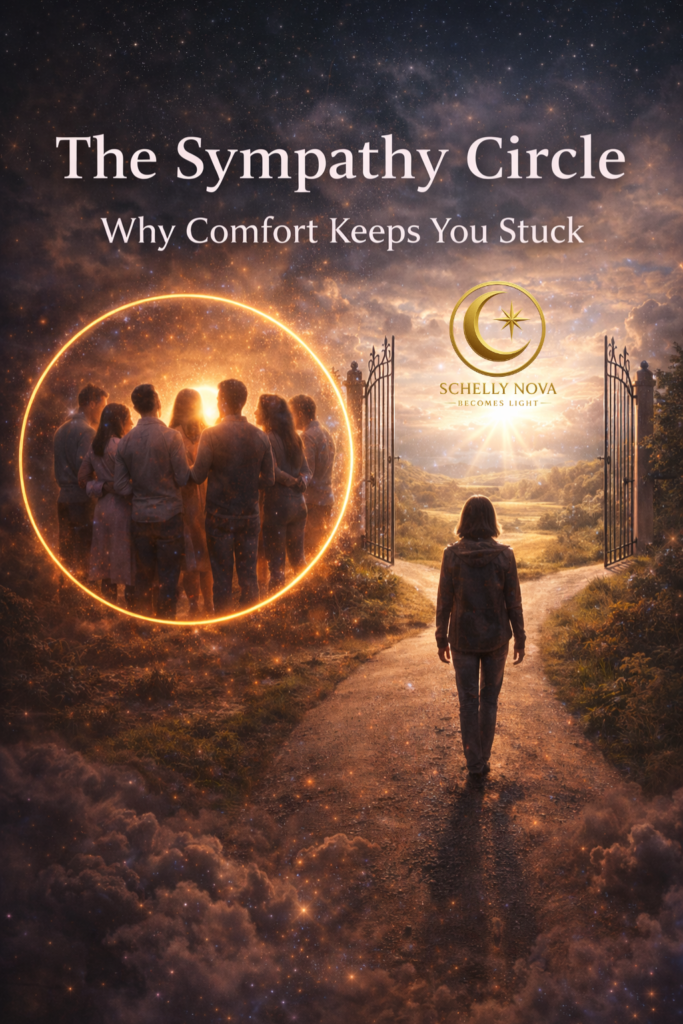
I call it the Sympathy Circle.
It’s where everyone understands you.
Where your frustrations make sense.
Where your reasons are validated.
Where nothing actually changes.
No one attacks you here.
No one pushes you here.
No one asks you to become more than you already are.
And that’s why it’s dangerous.
The Sympathy Circle isn’t toxic.
It isn’t cruel.
It isn’t malicious.
It’s built on shared struggle and shared stories.
Everyone inside it has a reason they’re stuck — and everyone agrees those reasons are valid. You’re supported, affirmed, and emotionally understood.
But there’s an unspoken trade:
You get comfort.
You give up momentum.
It feels like connection, but it’s actually containment.
No one challenges your ceiling.
Because if you grow, the circle has to look at itself.
The Sympathy Circle feels good because it removes pressure.
Your choices are explained away.
Your dissatisfaction is normalized.
Your fear is reframed as realism.
You don’t have to risk failure here.
You don’t have to risk change.
You don’t have to risk outgrowing anyone.
Comfort gets mistaken for connection.
And when you’ve been tired for a long time, comfort feels like relief.
Here’s the part most people never talk about.
People don’t repeat choices because they like them.
They repeat them because they know how to survive them.
Programming runs deeper than preference.
Your nervous system is wired by:
Familiar disappointment feels safer than unfamiliar hope.
So even when someone hates their choices, those choices feel predictable. Manageable. Known.
Growth threatens identity.
Change threatens belonging.
So the same decision gets made again — not out of laziness, but out of conditioning.
The Sympathy Circle doesn’t trap you.
It agrees with the part of you that’s afraid to change.
Everyone confirms the same beliefs:
The moment someone tries to break the pattern, the discomfort spreads.
Not anger — unease.
Because one person changing threatens the shared story.
So growth gets reframed as:
It’s not hostility.
It’s fear.
What’s really happening here is a quiet initiation. The moment you start seeing the pattern instead of defending it, you’ve already stepped into something new. Awareness creates distance, and distance creates choice.
This is the same transition explored in the larger shift from surviving patterns to transmitting who you’ve become.
No one writes these down, but everyone feels them.
If you follow the rules, you belong.
If you break them, you feel the distance.
That’s when guilt shows up.
Leaving the Sympathy Circle rarely feels empowering at first.
It feels lonely.
It feels selfish.
It feels like you’re abandoning people who “get” you.
But you’re not betraying them.
You’re being honest about who you’re becoming.
Outgrowing a circle isn’t rejection.
It’s truth.
And truth often costs familiarity.
Real support doesn’t just soothe you.
It strengthens you.
It sounds like:
Real support doesn’t need you to stay small so others can stay comfortable.
It expands when you expand.
The real cost of the Sympathy Circle isn’t failure.
It’s time.
Years pass quietly.
Potential calcifies.
Dreams become stories you tell instead of plans you make.
The most dangerous thing about the Sympathy Circle is that it feels kind.
And kindness without challenge can keep you exactly where you are.
Most people sense the gate long before they walk through it. They feel the discomfort, the restlessness, the knowing—but they hesitate because fear feels like a warning instead of an invitation.
That moment is described more fully in why fear often marks the exact threshold of growth.
You don’t need to burn bridges.
You don’t need to announce your exit.
You don’t need permission to grow.
You just need to choose growth over validation — again and again.
Not everyone meant to walk with you
is meant to walk
where you’re going.
And that’s not a tragedy.
That’s evolution.
You Were Born for the Roads They Fear
Astrology Is Data—You’re the Decoder
You must be logged in to post a comment.