
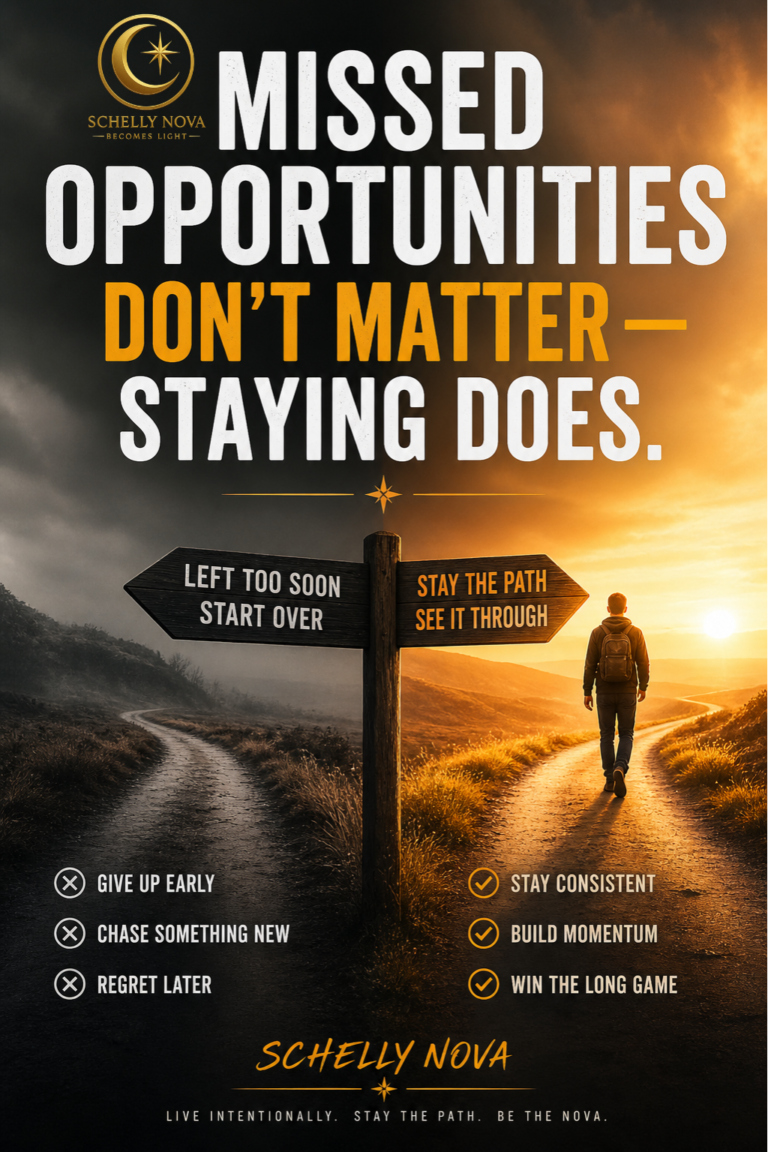
You think you missed it.
Wrong timing.
Wrong move.
Wrong moment.
Something you should have done.
Something you should have stayed with.
Something that looks obvious now.
And the story becomes simple:
“I missed my chance.”
But that’s not what happened.
You didn’t miss it.
You stepped away.
It only feels like you missed it because you’re looking backward.
You’re seeing the result…
without seeing the time it took to get there.
You’re seeing:
But you’re not seeing:
That part is invisible.
So when you look back, it feels like something appeared…
and you weren’t there for it.
But that’s not the truth.
You were there.
You just didn’t stay.
“It only looks like you missed it because you’re seeing the outcome without the timeline.”
Most people expect opportunity to show up early.
They think:
“If this is right, I’ll know quickly.”
“If this is working, I’ll see results soon.”
“If this matters, something should happen now.”
But that’s not how it works.
Opportunity doesn’t arrive on your timeline.
It builds quietly.
Slowly.
Without signaling.
And by the time it becomes visible…
most people are already gone.
“Opportunity shows up late—after most people have already left.”
There’s a part of every path that feels empty.
No feedback.
No traction.
No visible progress.
You’re doing the work…
but nothing is reflecting back.
That’s the moment everything gets tested.
Not your ability.
Your willingness to stay.
Because without proof, without momentum, without validation…
it starts to feel like you’re wasting time.
So people leave.
Not because it wasn’t working.
Because it wasn’t working yet.
“Every path gets quiet before it becomes valuable.”
This is where the story changes.
You didn’t miss something rare.
You left something early.
And when you look back now, it feels like loss.
But it wasn’t loss.
It was timing.
Not the kind you think.
The kind you didn’t stay long enough to meet.
Most people don’t make a clear decision to stop.
They don’t say, “I’m done.”
They just… step away.
A little less effort.
A little less focus.
A little more distraction.
They miss a day.
Then another.
Then the rhythm breaks.
Nothing dramatic happens.
But everything changes.
“You don’t always walk away. You slowly stop showing up.”
You don’t lose progress all at once.
You lose it in small shifts.
A new idea catches your attention.
Something easier looks more appealing.
A faster path promises quicker results.
And it feels harmless.
It even feels productive.
But every time your focus moves…
your momentum resets.
You go from building something…
to starting again.
“Every shift in focus feels small. But it resets everything.”
This is how your attention gets pulled away from what actually matters—quietly, consistently, and without resistance. It’s a pattern explored more deeply in The War for Your Consciousness, where awareness becomes the difference between drifting and directing your life.
When you step away, nothing immediately breaks.
You don’t feel the loss.
There’s no clear signal that you made a mistake.
That’s why it’s easy to justify.
“I’ll come back to it.”
“I just need a break.”
“I’ll restart when I’m ready.”
And maybe you do come back.
But something is different.
The rhythm is gone.
The edge is softer.
The version of you that was building something has to be rebuilt.
You don’t lose everything.
But you lose your position.
“You don’t feel the loss immediately. You feel it later.”
Switching paths feels active.
It feels like you’re doing something.
You’re thinking.
Planning.
Starting something new.
But progress doesn’t come from movement alone.
It comes from direction held over time.
Without that, everything becomes temporary.
Every effort becomes a restart.
Every restart delays the outcome.
“You’re not stuck because nothing is happening. You’re stuck because nothing is lasting.”
No one thinks they’re quitting too early.
There’s always a reason.
And sometimes those reasons sound right.
That’s what makes them dangerous.
Because they protect the decision to leave…
without ever testing what would have happened if you stayed.
This is the part people don’t talk about.
Some opportunities do come back.
Markets shift.
Trends cycle.
Doors reopen.
shows up again.
And for a moment, it feels like another chance.
Like you didn’t miss it after all.
But something is different.
You’re not in the same position.
You’re starting from the beginning again.
You’ve lost your place.
You’ve lost the version of you that was already building momentum.
Meanwhile…
someone else stayed.
“Opportunities repeat. Positioning doesn’t.”
Opportunity doesn’t choose randomly.
It aligns with position.
With consistency.
With time invested.
With someone who didn’t leave when it was quiet.
So when it returns…
it doesn’t reward the person who left and came back.
It rewards the one who never left.
The one who stayed when nothing was happening.
The one who kept showing up without proof.
The one who didn’t need it to feel good to continue.
“When it comes back, it rewards the one who stayed.”
You don’t feel regret while you’re leaving.
You feel relief.
It feels like the right move.
Like you’re choosing something better.
Like you’re correcting your path.
Regret comes later.
When you see what it became.
When you realize what it could have been.
When the timeline finishes… without you in it.
That’s when clarity shows up.
Too late to benefit from it.
“Regret isn’t missing it. It’s seeing what would’ve happened if you stayed.”
This is the part that separates everything.
Not timing.
Not luck.
Not finding the perfect opportunity.
Staying.
Staying when it’s slow.
Staying when it’s quiet.
Staying when nothing is confirming that you’re right.
Because staying builds something most people never reach.
Momentum.
Skill.
Position.
Identity.
This is the version of you that requires discipline to stay consistent—the one that doesn’t leave when it gets quiet, but keeps building anyway.
“Discipline is staying when there’s nothing telling you to stay.”
Most people think the answer is out there.
A better idea.
A better opportunity.
A better path.
But that’s not what’s missing.
What’s missing is time… applied in one direction.
Long enough for something to actually happen.
You don’t need something new.
You need to stop leaving.
You didn’t miss it.
You left.
And when it comes back—
it won’t reward the version of you that walked away.
It will reward the one who stayed.
So the question isn’t what’s next.
It’s whether you’re done leaving.
Silence Isn’t Weak — It’s Weaponized
Every Scar Has Strategy Behind It
When You Choose Power Over Performance
The Blueprint They Hid In Plain Sight
You must be logged in to post a comment.